A damaged, missing, or discolored tooth can affect more than just your smile — it can affect how confidently you speak, eat, and show up in everyday life. The good news is that modern dentistry offers more than one way to fix it. Two of the most common solutions patients ask about are dental implants and dental bonding.
While both treatments can restore your smile, they solve very different problems. Dental bonding is a cosmetic fix for minor imperfections on an existing tooth. Dental implants are a permanent replacement for a tooth that is missing or beyond saving. Choosing the wrong one — or not understanding the difference — can mean paying for a treatment that doesn’t actually solve your problem.
This guide breaks down exactly what each treatment involves, how they compare on cost, durability, and recovery, and how to know which one fits your situation.
What Is Dental Bonding?
Dental bonding is a conservative, cosmetic dental procedure in which a dentist applies a tooth-colored composite resin to the surface of a natural tooth. The resin is shaped, hardened with a curing light, and polished to blend in with the rest of your smile.
Bonding works because it attaches directly to your existing tooth structure — it doesn’t replace the tooth, it improves it. That’s why it’s typically used for:
- Small chips or cracks in the enamel
- Minor gaps between front teeth
- Discoloration that whitening can’t correct
- Slightly short or uneven teeth
- Small cavities in visible areas
The process is quick, usually completed in 30 to 60 minutes per tooth, and most patients don’t need anesthesia. Because so little of the natural tooth is altered, bonding is considered reversible and one of the least invasive cosmetic treatments available.
What Are Dental Implants?
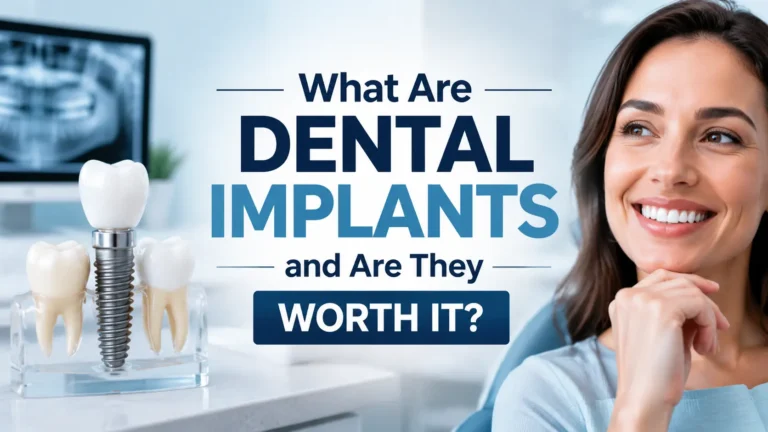
Dental implants are a permanent, surgical solution for replacing a tooth that is missing entirely — whether from decay, trauma, gum disease, or extraction. Unlike bonding, which works on a tooth you still have, an implant replaces the entire tooth, root and all.
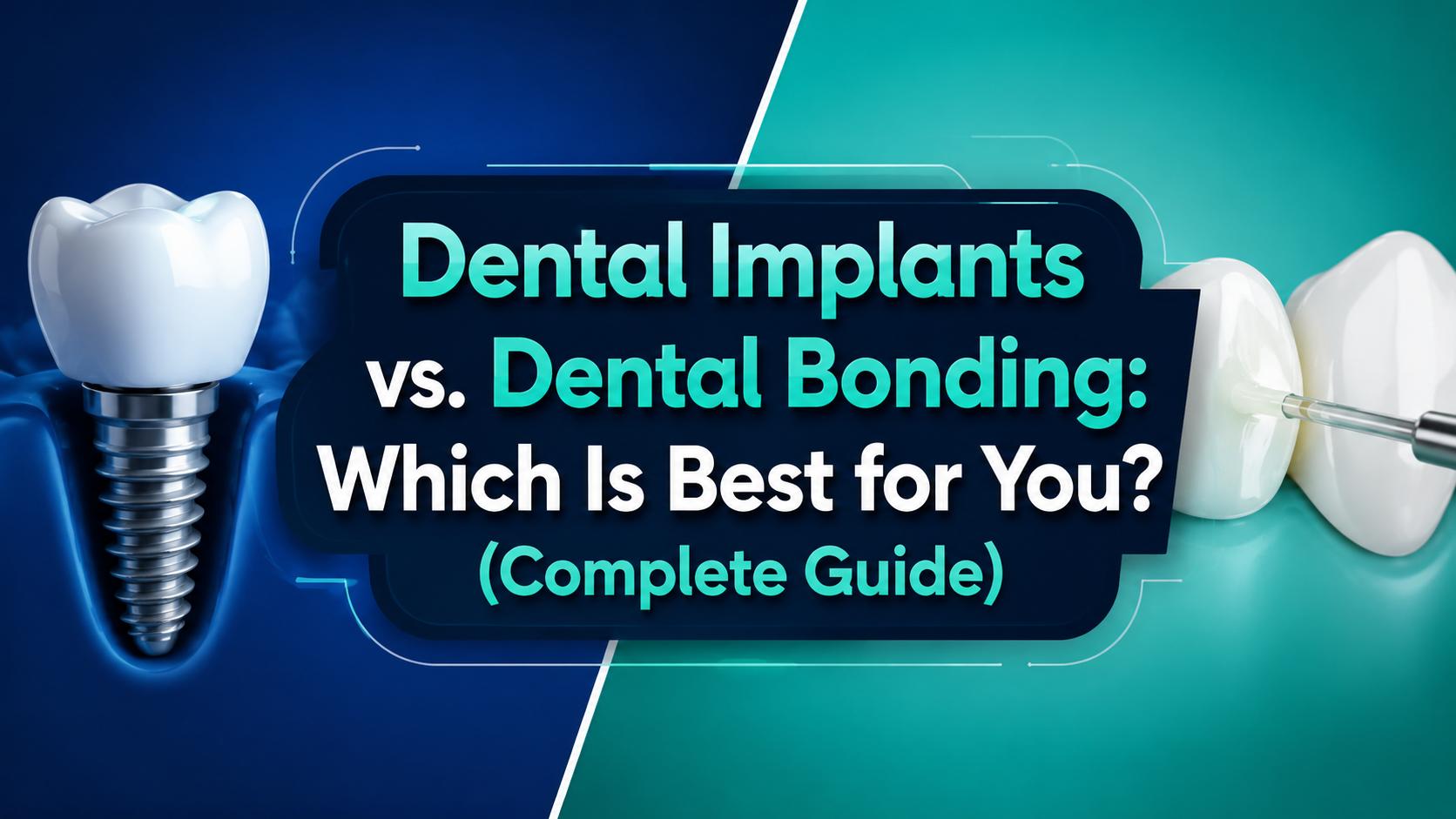
An implant has three parts:
- The implant post — a small titanium or zirconia screw surgically placed into the jawbone, acting as an artificial tooth root
- The abutment — a connector piece attached to the post
- The crown — a custom-made, tooth-colored cap that sits on top and looks like a natural tooth
Because the post fuses with the jawbone over several months in a process called osseointegration, implants function and feel like natural teeth. They also help preserve jawbone density, which naturally deteriorates after a tooth is lost.
Implants are typically recommended for:
- A single missing tooth
- Multiple missing teeth
- Teeth that are too damaged or decayed to save
- Patients looking for a long-term, low-maintenance replacement
Dental Implants vs. Dental Bonding: Key Differences
The clearest way to understand these two treatments is to see them side by side.
Factor | Dental Bonding | Dental Implants |
What it treats | Minor cosmetic flaws on an existing tooth | A completely missing or unsalvageable tooth |
Invasiveness | Minimal — no drilling into the tooth root or jaw | Surgical — requires placement into the jawbone |
Procedure time | 30–60 minutes per tooth, often same day | Several months total, including healing time |
Anesthesia | Usually not needed | Local anesthesia or sedation required |
Lifespan | 3–10 years on average | 15–25+ years, often a lifetime with care |
Reversibility | Reversible | Permanent |
Average cost per tooth | $100–$400 | $3,000–$6,000+ (including crown and abutment) |
Recovery | None — resume activities immediately | Days to weeks, with full healing over 3–6 months |
Stain resistance | Lower — resin can absorb stains | High — implant crowns resist staining well |
Best suited for | Cosmetic touch-ups on a healthy tooth | Replacing a lost or badly damaged tooth |
Which One Actually Solves Your Problem?
The most important question isn’t “which is better” — it’s “which one is designed for what I actually need.”
Choose Dental Bonding If:
- You have a tooth that is still structurally present and healthy
- Your concern is cosmetic — a chip, gap, or stain
- You want a same-day, budget-friendly fix
- You’re not ready for a permanent change
Choose Dental Implants If:
- A tooth is missing, cracked below the gumline, or too decayed to restore
- You want a permanent, natural-feeling replacement
- You’re experiencing bone loss from a missing tooth
- You want to avoid the ongoing upkeep of removable options like dentures or bridges
A simple way to think about it: bonding repairs what you have. Implants replace what you’ve lost. If you try to use bonding to “fix” a tooth that’s actually missing or severely broken beneath the surface, it won’t hold up — the underlying problem is structural, not cosmetic.
Example Scenarios
Case 1: The Chipped Front Tooth A patient chips the edge of a front tooth in a minor accident. The tooth is otherwise healthy and intact. This is a textbook case for bonding — the dentist matches the resin shade, shapes it to the chipped edge, and the patient leaves with a restored smile in under an hour.
Case 2: The Failed Root Canal A patient has a tooth that underwent a root canal years ago, but the tooth has since cracked below the gumline and is no longer restorable. Bonding cannot rebuild a tooth that doesn’t have enough remaining structure to support it. In this case, the tooth needs to be extracted and replaced with a dental implant to restore full chewing function and prevent bone loss in the jaw.
Case 3: Multiple Missing Teeth A patient who lost several back molars years ago now has visible bone loss and difficulty chewing. Bonding isn’t relevant here since there’s no tooth structure to bond to. Implants — potentially supported by an implant bridge — replace the missing teeth from the root up and restore normal function.
Cost Comparison: What You’re Really Paying For
At first glance, bonding looks like the obvious budget choice. But the cost comparison only makes sense when the treatments are solving the same problem — and often, they aren’t.
- Dental bonding costs $100 to $400 per tooth and needs to be touched up or replaced roughly every 3 to 10 years.
- Dental implants cost $3,000 to $6,000+ per tooth (including the post, abutment, and crown), but are designed to last 15 to 25 years or longer with proper care — often functioning as a one-time investment.
If you have a healthy tooth with a cosmetic flaw, bonding is almost always the more cost-effective route. If you’re missing a tooth, comparing its price to bonding isn’t a fair comparison — bonding simply isn’t built to replace a missing tooth, no matter how affordable it is.
Many practices also offer financing plans or in-house membership plans that make implant costs more manageable, and dental insurance may cover part of the cost when the implant is medically necessary rather than purely cosmetic.
Procedure and Recovery: What to Expect
Dental Bonding
- Your dentist selects a resin shade to match your natural teeth
- The tooth surface is lightly roughened and a bonding agent is applied
- The resin is shaped directly onto the tooth
- A curing light hardens the material in seconds
- The tooth is polished to a natural finish
There’s no downtime. You can eat, drink (aside from staining beverages for the first day or two), and speak normally right after your appointment.
Dental Implants
- Consultation and imaging — X-rays or a 3D scan assess bone density and plan implant placement
- Implant placement — the titanium post is surgically placed into the jawbone
- Healing period (osseointegration) — typically 3 to 6 months for the bone to fuse around the post
- Abutment and crown placement — once healed, the connector and custom crown are attached
Recovery from the surgical step usually involves mild swelling and soreness for a few days, managed with over-the-counter pain relief. The full process, from consultation to final crown, generally spans several months — but the result is a tooth that functions like a natural one for decades.
Maintenance: Keeping Your Results Looking Good
For bonded teeth:
- Brush twice daily with a soft-bristled brush
- Avoid biting hard objects like ice, pens, or fingernails
- Limit staining foods and drinks such as coffee, tea, and red wine
- See your dentist every six months to check for chips or wear
- Consider a nightguard if you grind your teeth
For dental implants:
- Brush and floss around the implant just like a natural tooth
- Use an antimicrobial or alcohol-free mouth rinse if recommended
- Avoid chewing on very hard foods that could damage the crown
- Keep up with regular cleanings and checkups to monitor gum health around the implant
- Address teeth grinding, as excess pressure can affect the implant over time
Implants don’t stain or decay the way natural teeth or composite resin can, but the surrounding gum tissue still needs to stay healthy to keep the implant stable long-term.
Frequently Asked Questions
Can dental bonding be used to replace a missing tooth?
No. Bonding only works on a tooth that is still present and has enough healthy structure to bond to. A missing tooth requires a replacement option like an implant, bridge, or partial denture.
Are dental implants painful?
The placement procedure is done under anesthesia, so patients don’t feel pain during surgery. Mild soreness and swelling afterward are normal and typically resolve within a few days with standard aftercare.
Is dental bonding a permanent solution?
Not exactly — bonding typically lasts 3 to 10 years and will eventually need to be touched up or replaced. It is, however, fully reversible, unlike implants or veneers.
Which option lasts longer?
Dental implants last significantly longer, often 15 to 25 years or more, compared to bonding’s typical 3-to-10-year lifespan. This is because implants replace the entire tooth structure rather than layering material onto an existing surface.
Can I get bonding and implants at the same time for different teeth?
Yes. It’s common for patients to need different treatments for different teeth — for example, bonding a chipped front tooth while getting an implant to replace a missing molar. A comprehensive exam will determine the right approach for each tooth.
Does insurance cover these treatments?
Coverage varies. Bonding done for purely cosmetic reasons is typically not covered, while bonding needed to repair damage or decay may be. Implants are sometimes partially covered when medically necessary, though coverage differs by plan.
Making the Right Choice for Your Smile
Dental bonding and dental implants aren’t competitors for the same job — they’re tools designed for different situations. Bonding is the fast, affordable way to touch up a tooth you still have. Implants are the long-term way to replace a tooth you’ve lost.
The best way to know which one is right for you is a professional evaluation. A dentist can assess the health of your teeth, gums, and jawbone, and recommend the treatment that actually solves your specific concern — not just the one that sounds simpler.
Ready to find out which option fits your smile? Schedule a consultation with our team to get a personalized recommendation based on your oral health and goals.